
The Birth of an Idea
In 1991, Adobe co-founder Dr. John Warnock initiated an internal project that would forever change document sharing. The project, codenamed "Camelot," aimed to solve a fundamental problem of the digital age: how to share documents across different computer systems while preserving their exact appearance, fonts, graphics, and layout.
Warnock's vision was simple yet profound: create a universal document format that would allow anyone to capture documents from any application, send electronic versions of these documents anywhere, and view and print them on any machine. This vision was outlined in a white paper titled "The Camelot Project," which laid the foundation for what would become the Portable Document Format (PDF).
John Warnock's Vision
Dr. John Warnock, who founded Adobe Systems in 1982, recognized early on that the digital revolution would require a new way to share information. Before PDF, sharing documents electronically was problematic: recipients needed the same software and fonts as the creator, and documents often looked different on different computers or printers.
Warnock envisioned a world where documents could be created on any computer, transmitted electronically, and viewed or printed on any other computer without loss of fidelity. This would enable true paperless communication and preserve the author's intended design regardless of the recipient's system configuration.
"The idea was to create a universal way to communicate documents across a wide variety of machine configurations, operating systems, and communication networks."
— Dr. John Warnock, Adobe Co-founder
The Evolution of the Format
1993: PDF 1.0 Release
Adobe released the first version of PDF along with Adobe Acrobat software. Initial adoption was slow due to the need for expensive Acrobat software and the large file sizes generated. PDF files were often too large to easily share over the internet connections of that era.
1994-1996: Gaining Momentum
Adobe released improved versions (PDF 1.1 and 1.2) with better compression, security features, and support for interactive elements like forms and hyperlinks. The introduction of the free Adobe Acrobat Reader significantly accelerated adoption, as anyone could now view PDF documents without purchasing expensive software.
2000: Mass Adoption
With PDF 1.4, Adobe introduced features like transparency, Tagged PDF for accessibility, and better support for multimedia content. By this time, PDF had become widely accepted for professional document exchange, digital printing, and archival purposes.
2008: Open Standard
In a landmark decision, Adobe released PDF 1.7 as an open standard (ISO 32000-1:2008) governed by the International Organization for Standardization (ISO). This move cemented PDF's position as a universal document format and encouraged wider adoption and innovation by third-party developers.
2017-present: PDF 2.0 and Beyond
PDF 2.0 (ISO 32000-2:2017) introduced modern features including better encryption, improved multimedia support, and enhanced accessibility. Today, PDF continues to evolve with new standards like PDF/A for archiving, PDF/X for printing, PDF/E for engineering, and PDF/UA for universal accessibility.
Modern PDF Usage
Today, PDF is ubiquitous in both professional and personal contexts. Here are some impressive statistics demonstrating its global impact:
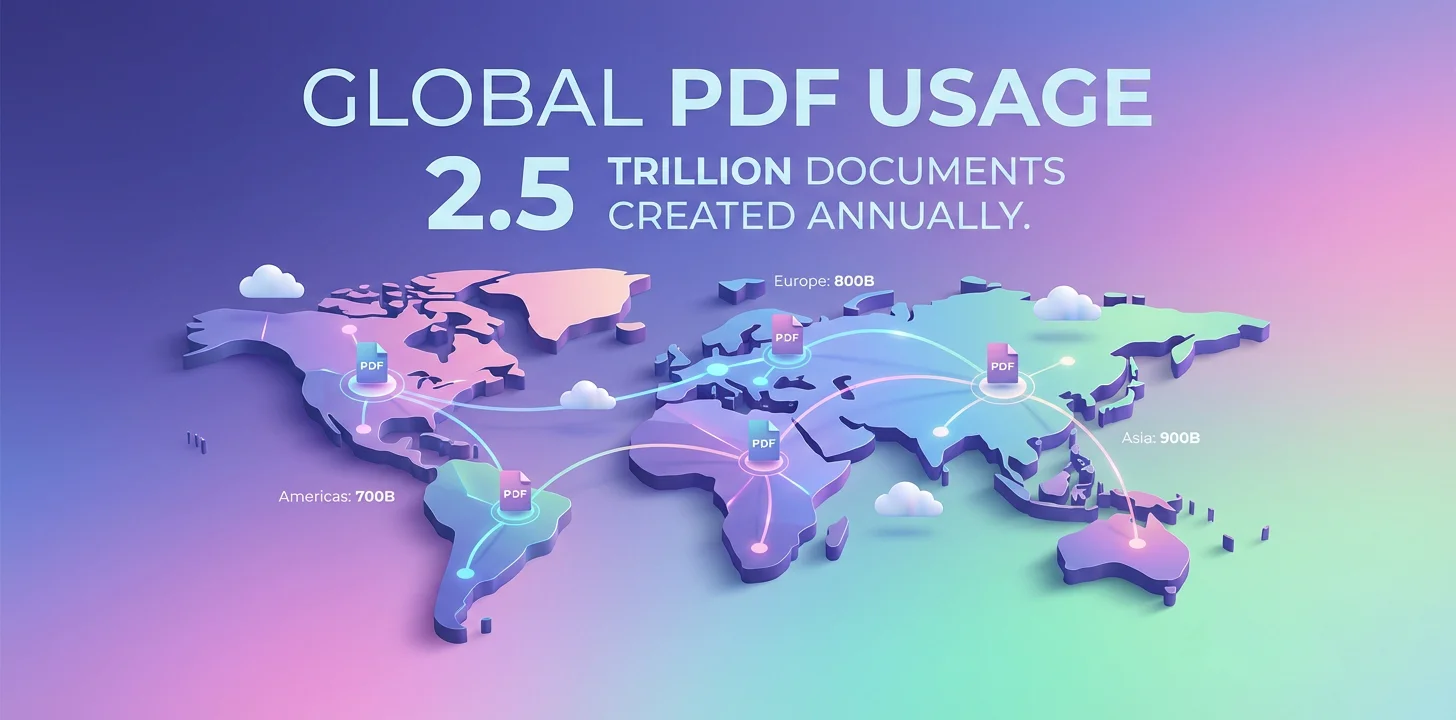
PDF documents created annually worldwide
People regularly use PDF for work or personal tasks
Of organizations use PDF as their standard document format
From government to healthcare, education to finance
PDFs are used for contracts, invoices, resumes, research papers, e-books, government forms, legal documents, marketing materials, technical manuals, and countless other applications. The format has become so integral to digital communication that it's hard to imagine modern business or education without it.
An Enduring Legacy
What began as John Warnock's vision of a "paperless office" has evolved into something much greater: a universal language for documents that transcends platforms, devices, and borders. PDF has democratized document sharing and preservation, ensuring that information created today can be accessed exactly as intended for decades to come.
As we move further into the digital era, PDF continues to adapt and evolve, incorporating new technologies while maintaining its core promise: reliable, consistent document presentation for everyone, everywhere.
Trademark Notice: Adobe, Acrobat, and PDF are either registered trademarks or trademarks of Adobe Inc. in the United States and/or other countries. All other trademarks are the property of their respective owners. This site is not affiliated with, endorsed by, or sponsored by Adobe Inc.
Try Modern PDF Editing
While PDF has evolved significantly since 1993, our editor brings you the latest capabilities for working with PDF documents securely in your browser.
Try Our Free PDF Editor